

ORDA
Qasqa Jol cropped boxy top
25 000 ₸
The bright road of steppe law.
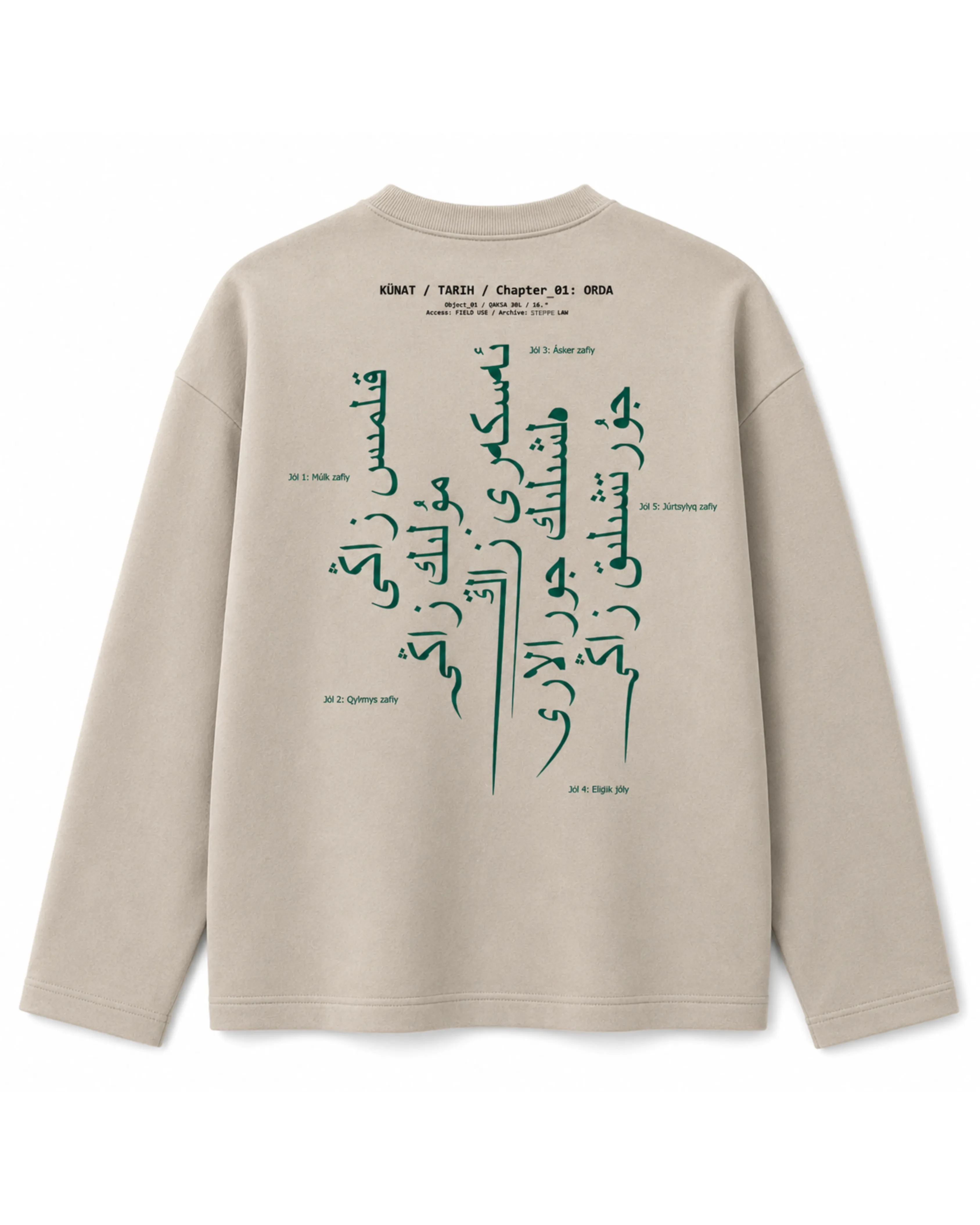
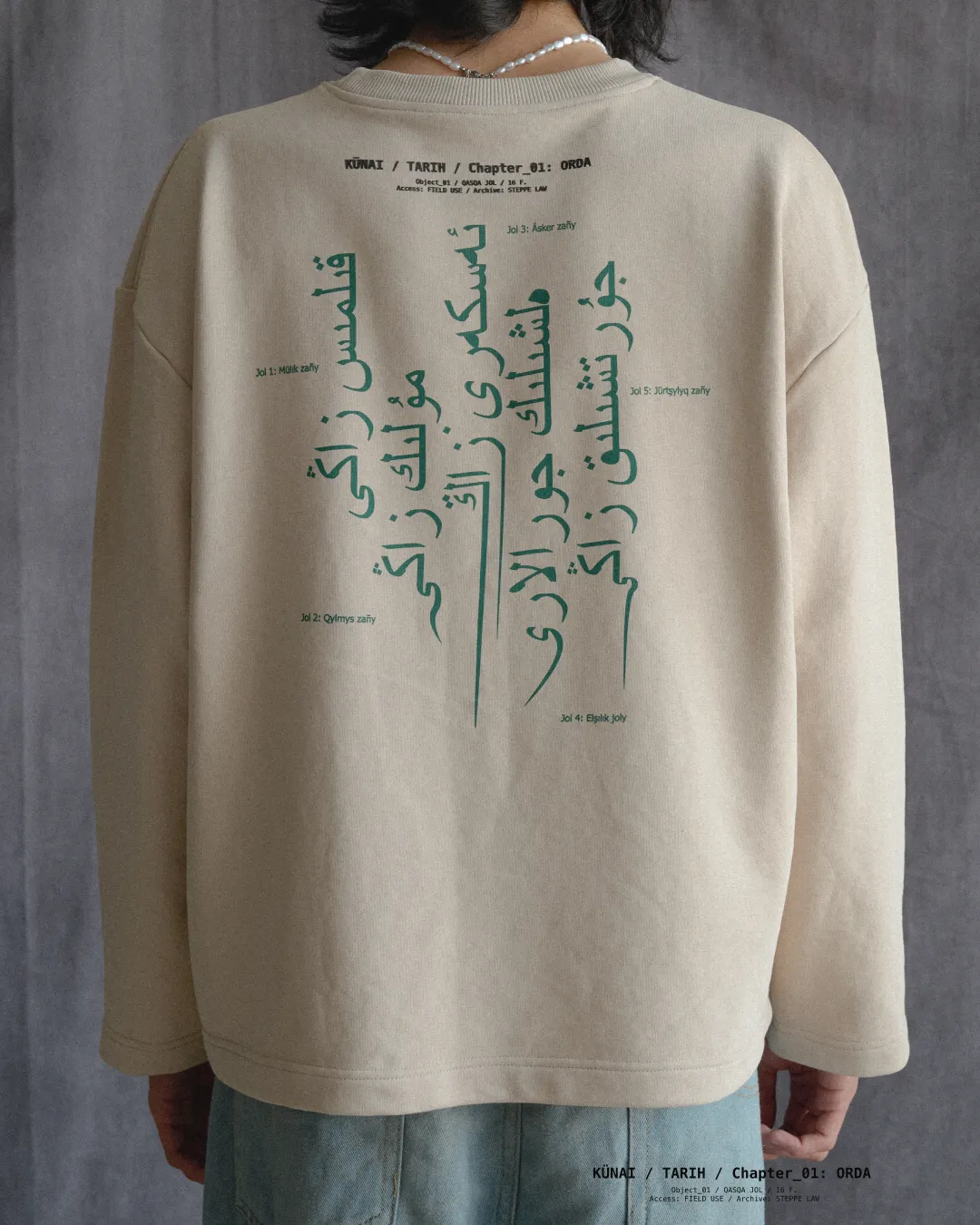
A utilitarian boxy top as part of the KRI field archive. On the back, the five “jol” of Kasym Khan’s code rendered in Arabic script.
Orda is the collection's nomadic point of departure: the name spans the whole precolonial history, from Orda-Ichen's Ak Orda to the Kazakh Khanate of 1465. The graphics turn to Kasym Khan's "Qasqa Zhol", the khanate's first legal code, as a metaphor of the path through the ages.
The five chapters of Kasym Khan's law are shown as five diverging roads in Arabic script, historically native to the Kazakhs and a visual image of flow. The piece is anchored in archaeology, hence its utilitarian, minimalist character that does not drown out the graphics.
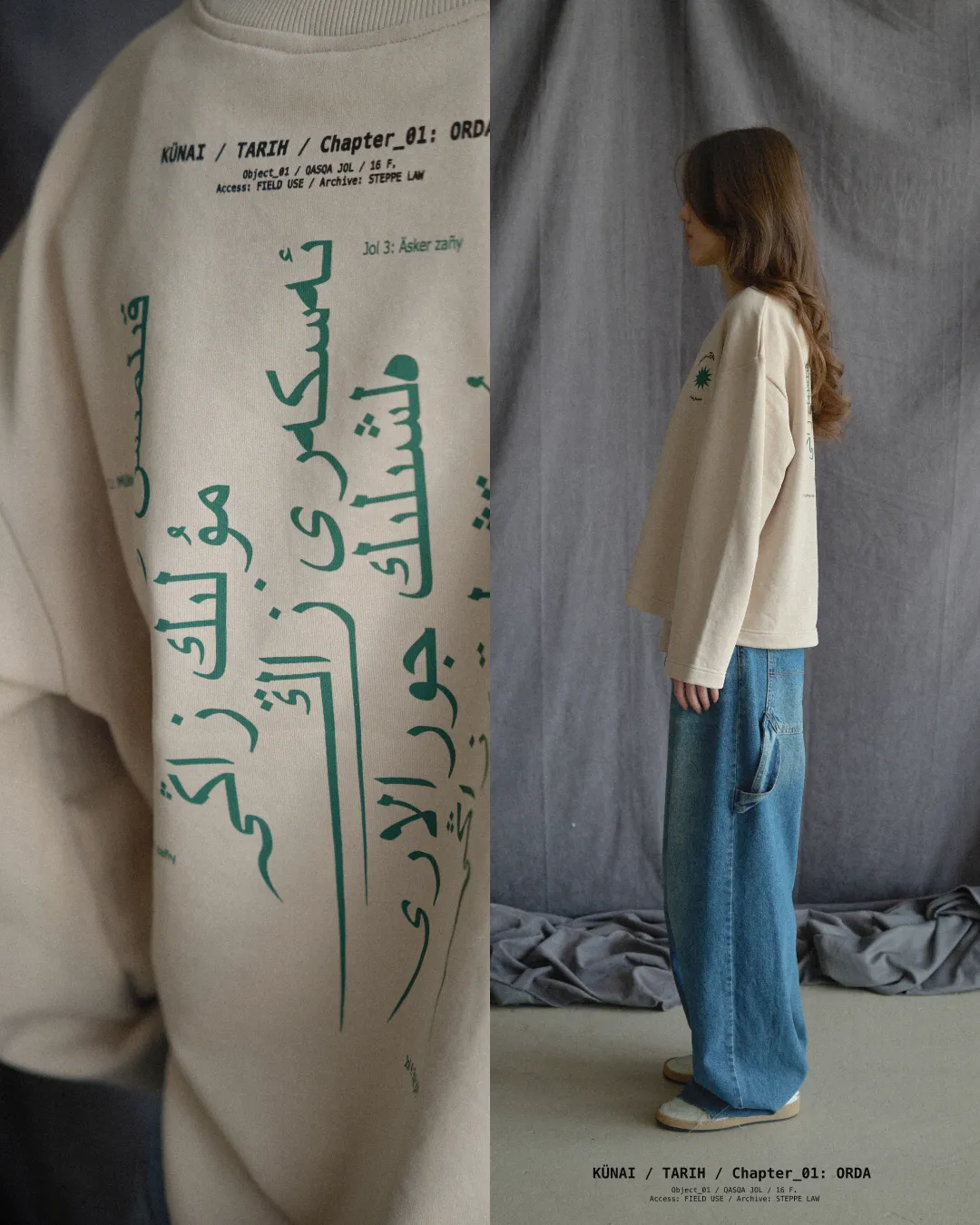
A dusty-sand cropped boxy top as part of the KÜNAI Research Institute field uniform; on the back, a calligraphic composition of five "zhol" columns reads as a diagram of steppe law. The archival marking above shifts the object into the format of a research specimen.









ORDA
Source
The aim of the collection is to tell the history of Kazakhstan through clothing, to show the march of history in every object. Orda became the logical point of departure: the nomadic era.
The name “Orda” was chosen deliberately: it encompasses the whole of our nomadic history, not only the period of the Kazakh Khanate. The Khanate was founded in 1465, but it did not arise from nothing. The true beginning of the Kazakh heritage was laid earlier, with the founding of the Ak Orda under Orda-Ichen, within the Golden Horde. Another reminder that our history is a long march through the ages.
The object’s graphics turn to “Qasqa Zhol”, the “Bright Path” of Kasym Khan. The choice is dictated by the academic nature of our brand, the Künai Research Institute. And what could be more academic than the study of law? The law of Kasym Khan is the first legal code in the history of the Kazakh Khanate. Before it, the steppe relied on ancient Mongol law. It is telling, too, that the law of Kasym Khan always exists as the first link in a chain: it is followed by the laws of Esim Khan and Tauke Khan, another expression of the flow of history.
The word “Orda” itself carries more meaning than first impressions suggest. In the Turkic and Mongolic languages, an orda is a headquarters, the court of a ruler, a mobile capital that moves together with the army and the auls. It is a form of statehood without fixed geography: a political center that lives to the rhythm of the steppe. This is precisely why Orda is the exact name for the whole of our precolonial era: Kazakh statehood was born not within city walls but in the very logic of movement.
The Kazakh Khanate of 1465 was the result of the breaking-away of the sultans Zhanibek and Kerei from Abulkhair and their departure with their uluses into Moghulistan, into the valleys of the Chu and Talas rivers. But the roots of this division run deeper, to the Ak Orda, the eastern wing of the Golden Horde, where already in the 14th century a political body was forming that would in time become Kazakh. From Orda-Ichen to Urus Khan, from Urus Khan to Barak Khan, from Barak Khan to Zhanibek and Kerei: this is not an abstract continuity but a concrete line of succession.
Kasym Khan was not chosen by chance. In the early 16th century his reign marked the peak of the young khanate’s political consolidation: by tradition, as many as a million subjects were under his rule, and the borders stretched from the Yaik to the Irtysh. His “Qasqa Zhol”, the bright, clear path, was a code that returned the steppe to order after long internal strife. The very name of the law is telling: already a metaphor of the path. The Kazakh, who lived in motion, conceived of law too as a road: one can walk it or stray from it, but the road itself remains a constant.
Sources: National Encyclopedia; e-history.kz/ru/news/show/6277
Interpretation
The image of the “march of history” recurs for a reason: it is what gave rise to the graphics that became the object’s main element.
We needed an element of the Orda era capable of embodying that movement. It became “Qasqa Zhol”. The word “zhol”, path, conveys exactly the idea of a march, of a natural flow, of a road through time.
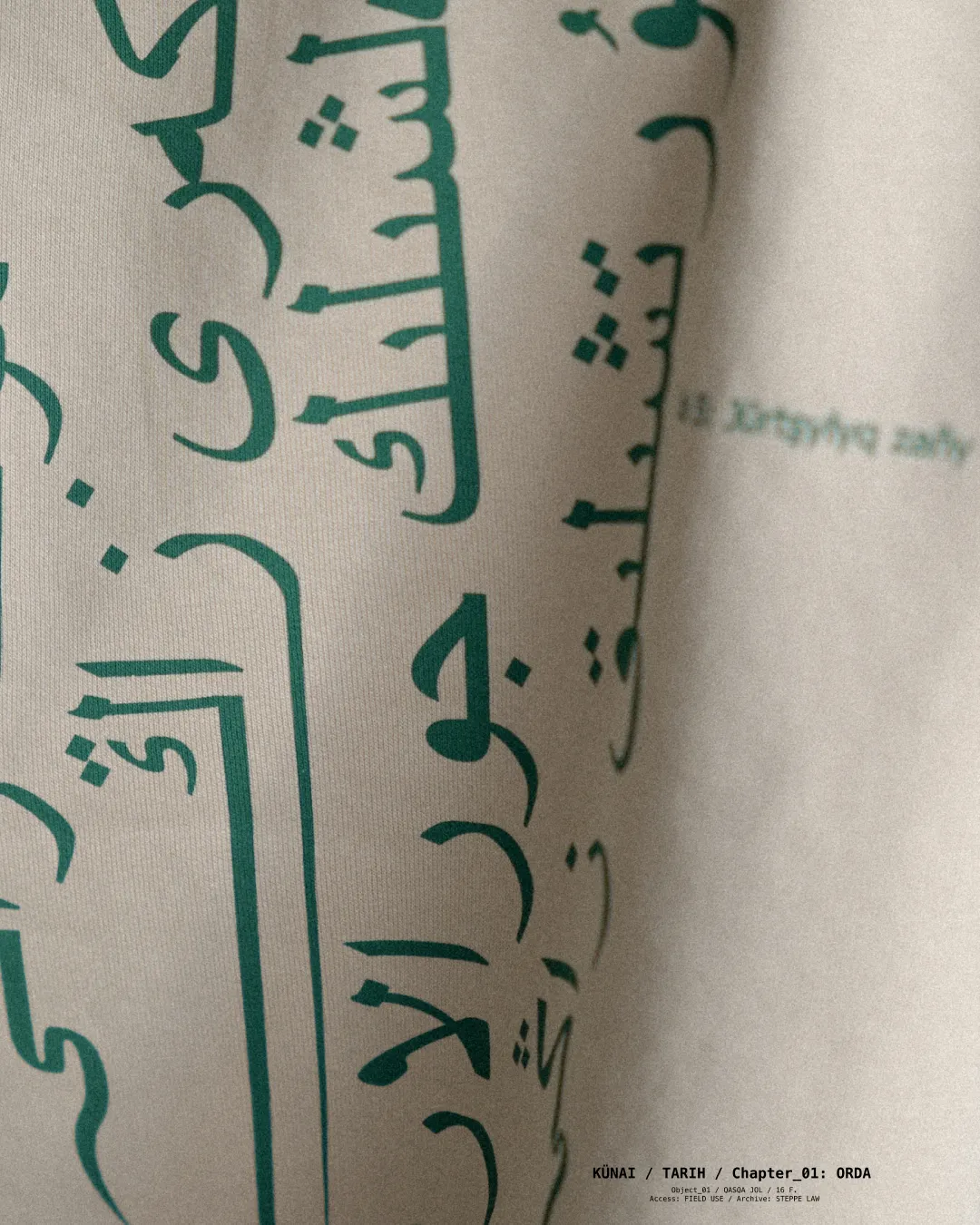
Next came the question of the graphics themselves. The law of Kasym Khan is divided into five chapters, and this prompted the idea of showing them as five diverging roads. At the same time came the decision to use Arabic script. First, the Arabic alphabet was historically native to the Kazakhs: had the law ever been set down in writing, it would have been recorded in it. Second, Arabic calligraphy is in itself a visual embodiment of flow, of a winding, endlessly unspooling trail.
This object is anchored in the collection not under archival study and chronicle-keeping but under archaeology. The Orda era left extremely few written records: most of what we know about it we owe to the works of Persian and Arab historians. Everything else is the achievement of archaeology. Hence the character of the piece: utilitarian, severe, substantial. We considered versions with additional details, pockets, zippers, but deliberately moved toward minimalism so as not to drown out the graphics themselves.
Object
ORDA, the cropped boxy top “Qasqa Jol”. A dusty-sand cropped boxy top with a utilitarian character, as an element of the research uniform of the field archive of the KÜNAI Research Institute.
On the back, a vertical composition of calligraphic elements in Arabic-Persian script. Several columns stand side by side and form a single block in which the lines run parallel downward, keeping a clear structure. The lines differ in form and thickness, creating a rhythm within the overall system. Around them are small captions that mark out individual directions and read like a diagram or a map.
The graphics refer to the laws of Qasym Khan, “Qasqa Zhol” (“Bright Path”), which was divided into five main sections:
- property law (Мүлік заңы)
- criminal law (Қылмыс заңы)
- military law (Әскер заңы)
- envoy law (Елшілік жолы)
- communal law (Жұртшылық заңы)
Each column corresponds to one “zhol”, one direction. The print reads as a diagram of steppe law: a set of parallel sections governing land, war, diplomatic protocol, crimes, and communal obligations.
At the top of the composition, an archival marking:
KUNAI / TARIH / Chapter_01: ORDA
Object_01 / QASQA JOL / 16 Ғ.
Access: FIELD USE / Archive: STEPPE LAW
This shifts the object into the format of a “research specimen”: before us is not merely a garment but a documented artifact from an institute of steppe law.